
Target Market
Fashion conscious millennial (22-37) women in New Zealand.
This decision was based on results from studies that this demographic spends the highest amounts on apparel annually (Antonow), and is most likely (compared to all other age/sex demographics) to use alternative fashion business models (Nielsen and Wencke 19).
Studies on the few currently operating fashion library businesses have recorded that members were often LOHAS consumers prior to joining the library. This means they would have already been consuming clothing responsibly by shopping second hand at ethical clothing brands. In order to generate change Refresh would target ‘Drifters’ these are consumers who care about the environment but convenience and trends take priority (LOHAS Consumers NMI).
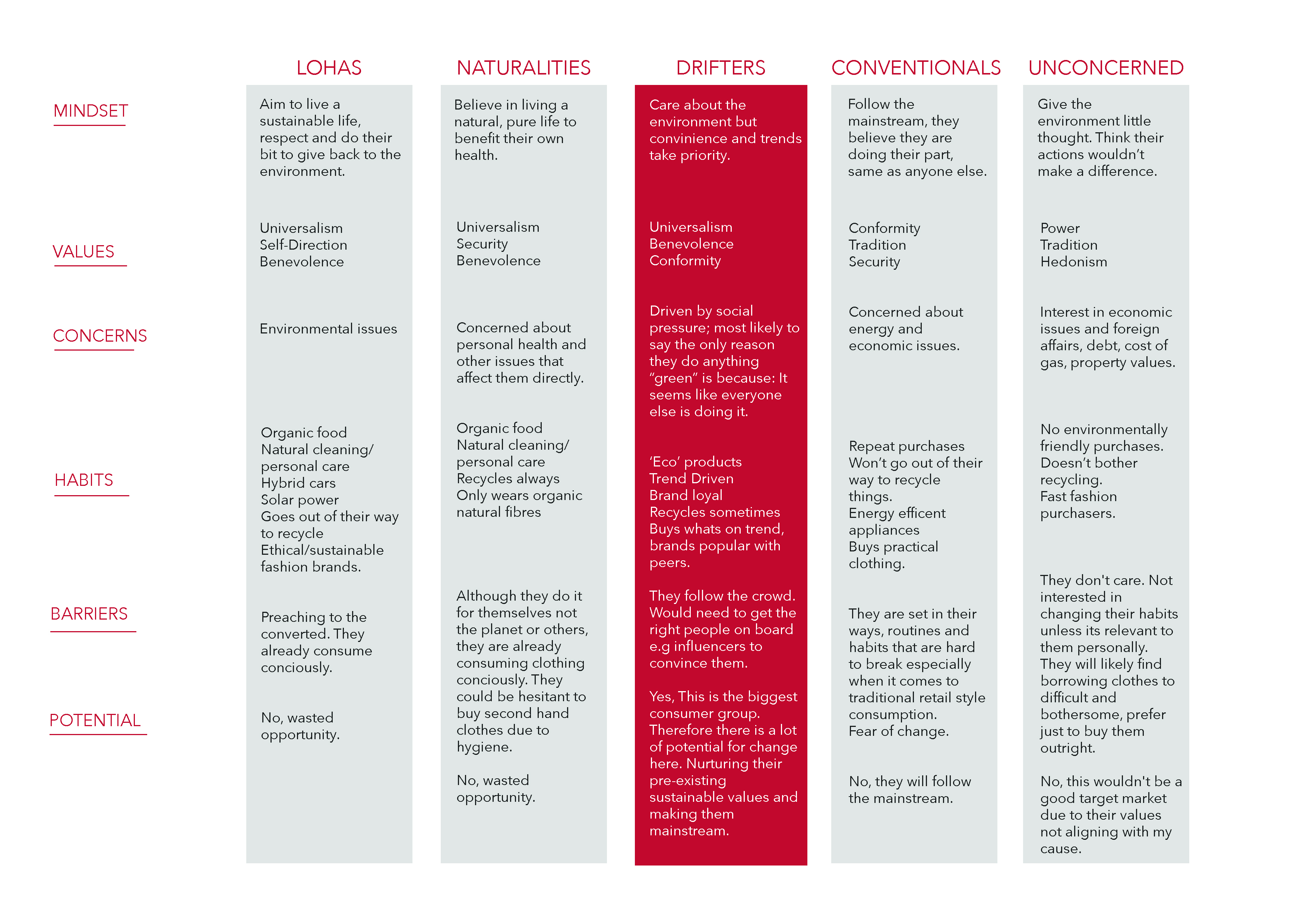
Target Market Profile
Lauren (25)
Lauren has a growing wardrobe of barely used garments and an enormous attitude behaviour gap in terms of sustainability. She cares about the environment and makes an effort to be sustainable in most aspects of her life, but when shopping for clothes her desire to be on-trend with a limited budget drives her to shop at fast fashion retailers. Lauren is social and doesn’t like to be seen in the same outfit twice, she shops weekly or even daily if you count online browsing.
Our Core Values
- Sustainability
- Ethics (Worker rights)
- Transparency (Supply chain & company practice)
- Empowering women
- High Quality
our Purpose
Slowing the fashion consumption cycle to reduce the industry’s environmental impact.
Globally, clothing utilisation has decreased by 36% over the last 15 years (yet up to 70% in some developed countries). Meanwhile, clothing production has approximately doubled. (Ellen MacArthur Foundation 18,19). This paradox is mainly caused by the fast fashion phenomenon. Lower prices, more collections, and quicker turnaround all contribute to the perception of clothing becoming increasingly disposable.
More than half of fast fashion garments are estimated to be disposed of within a year of production (Ellen MacArthur Foundation 19). Studies have estimated that garments are worn an average of 7-10 times before disposal (Lehmann, Morten, et al. 59). Furthermore, an Australian study report found that $1.56 billion AUD per year is spent on clothes that are never even worn (Payne 10). In an industry widely known to be one of the most resource intensive and polluting, these are statistics that need to change.
our vision
Our vision at Refresh is for the fashion industry to change from the current wasteful linear production system to be operating as a completely circular economy. It has been suggested by numerous studies that the most effective catalyst for creating this change from a bottom-up approach is increasing clothing usage (Ellen MacArthur Foundation, WRAP, Nielsen and Wencke).
We aim to slow down the consumption cycle of clothing by putting garments into circulation for collaborative consumption. We aim to increase the amount of times clothing is worn from 7-10 times to hundreds.
By just doubling the number of times clothes are worn on average, studies have shown the GHG emissions would lower 44% (Lehmann, Morten, et al. If this increase in wear could also increase a garments life by a mere three months its carbon, water and waste footprint would also decrease by 5-10% (WRAP).
Refresh hopes that by educating and actively involving consumers as members of the supply chain we can consequently enhance the perceived value of clothing and other resources and decrease negative environmental and social impacts.
Mission Statement
A well-crafted mission statement focuses the business for both employees and the target audience. It serves as a framework, giving everyone involved a launching point to build from when establishing the brand (Big Commerce).
Broad mission statements allow for business growth.
- Value – What is the value of the business to both customers and employees?
– Sustainable
– Ethical
– Affordable
– Experience
– Connection
– Variety
- Inspiration – Why should people want to work for the company?
– Innovative concept
– Revolutionising the way women shop
– Reducing waste
– Slowing the fashion consumption cycle
– Increasing clothing utilisation - Plausibility – Make it sound reasonable
– Make sure we don’t over-promise until we have worked out logistics. - Specificity – Tie it back to the business
– Millennial women are our target
– Fashion industry specifically, both everyday and occasion wear.
Our mission is to revolutionize the way millennial women shop for clothing by allowing them to borrow rather than buy their garments through our innovative fashion library. Ultimately increasing clothing utilization rates and slowing down the fashion consumption cycle.
Perhaps that is too specific? E.g Googles mission statement doesn’t mention being a search engine as they have grown beyond that. If we want our company to grow beyond being a fashion library platform perhaps I need to be more broad?
Our mission is to increase fashion utilization rates through revolutionizing the way millennial women shop.
Or we could just have ‘consumers’ if we don’t want to limit ourselves to women?
Brand positioning statement
“A positioning statement is a brief description of a product or service and target market, and how the product or service fills a particular need of the target market. It’s meant to be used as an internal tool to align marketing efforts with the brand and value proposition. (Hub Spot)
For [your target market] who [target market need], [your brand name] provides [main benefit that differentiates your offering from competitors] because [reason why target market should believe your differentiation statement.]
E.g
Apple: For individuals who want the best personal computer or mobile device, Apple leads the technology industry with the most innovative products. Apple emphasizes technological research and advancement and takes an innovative approach to business best practices — it considers the impact our products and processes have on its customers and the planet.
Mc Donalds: For individuals looking for a quick service restaurant with an exceptional customer experience, McDonald’s is a leader in the fast food industry, with its friendly service and consistency across thousands of convenient locations. McDonald’s’ dedication to improving operations and customer satisfaction sets it apart from other fast food restaurants
Refresh: For millennial women who want to continually update their wardrobe without contributing to a huge environmental footprint, Refresh enables members to borrow rather than buy their clothing from our library of sustainable and ethical fashion brands. Refresh’s commitment to ensuring transparent supply chains and circular systems set us apart from other fashion rental platforms.
Brand Slogan Ideas
- Borrow don’t buy.
- Buy less, wear more.
- Refresh your wardrobe.
- Refresh yourself.
Sources:
https://blog.hubspot.com/sales/positioning-statement
https://www.bigcommerce.com/ecommerce-answers/how-to-write-a-powerful-effective-mission-statement/
Ellen MacArthur Foundation. “A New Textiles Economy: Redesigning Fashion’s Future.” 2017.
Lehmann, Morten, et al. “Pulse of the Fashion Industry.” Global Fashion Agenda and The Boston Consulting Group, 2018.
Nielsen, Kristian Steensen, and Wencke Gwozdz. “Report on Geographic Differences in Acceptance of Alternative Business Models.” 2018.
WRAP. “Sustainable Clothing: A Practical Guide to Enhancing Clothing Durability and Quality.” 2017.

 Refresh Fashion Library