
In order to back up our assumption that there is a problem with clothing consumption being underutilised and having a huge environmental impact we have conducted some research summarised below:
Ellen MacArther Foundation
A charity based in the UK, “aims to inspire a generation to re-think, re-design & build a positive future through the framework of a circular economy.”
Their 2017 report “A New Textiles Economy: Redesigning fashion’s future” looks at how the industry currently operates and how it could transition to a ‘circular economy’ that delivers better economic, societal, and environmental outcomes.
Statistics:
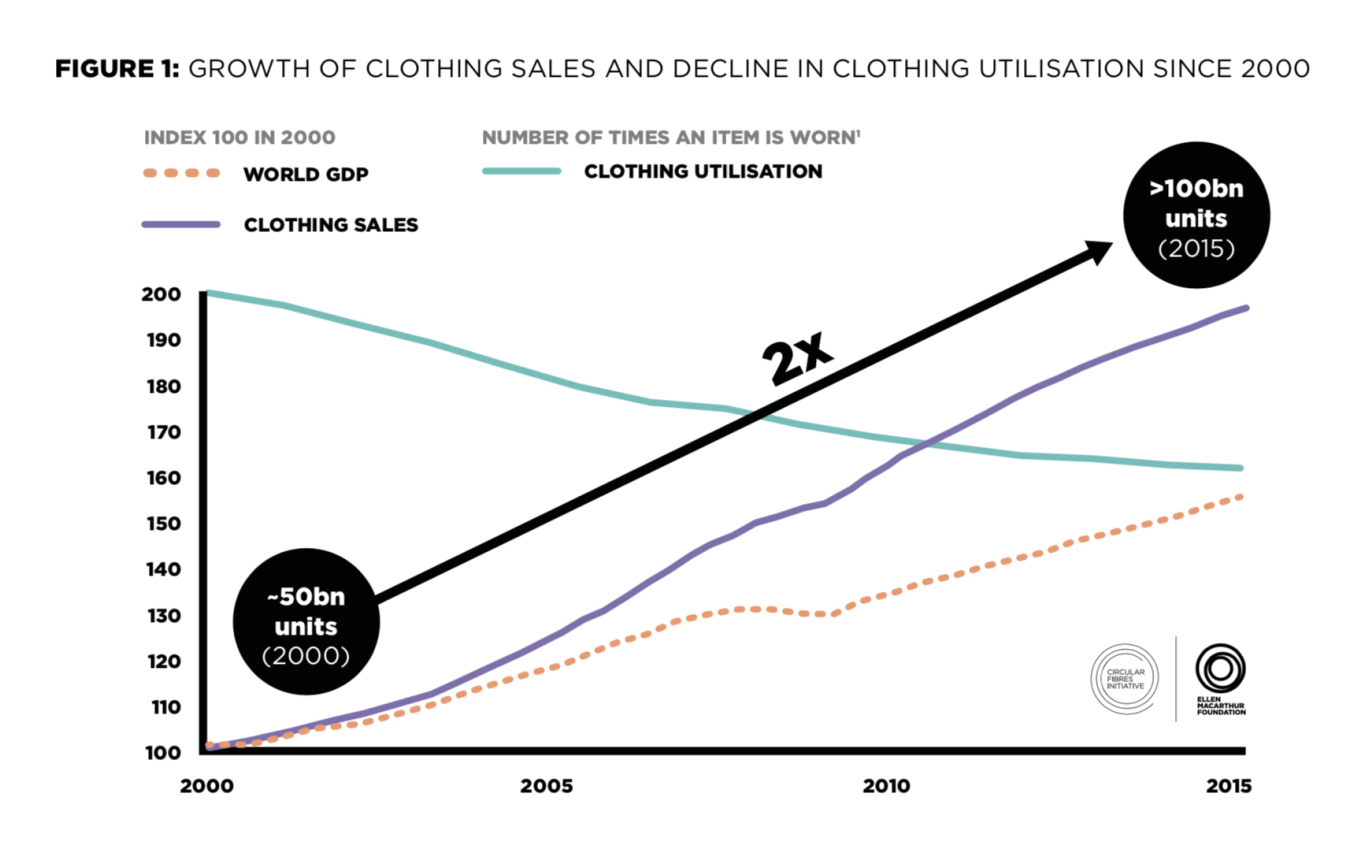
- In the last 15 years, clothing production has approximately doubled. They claim this is driven by a growing middle-class population across the globe and the ‘fast fashion’ phenomenon, with quicker turnaround of new styles, increased number of collections offered per year, and lower prices.
- It is estimated that more than half of fast fashion produced is disposed of in under a year.
- Clothing is massively underutilized. Worldwide, clothing utilisation – the average number of times a garment is worn before it ceases to be used – has decreased by 36% compared to 15 years ago. This statistic is skewed as many developing countries are actually underconsumers… rates of utilisation have decreased by as much as 70% in developed countries such as China.
- Garments are estimated to be discarded after just seven to ten wears.
- Customers miss out on USD 460 billion of value each year by throwing away clothes that they could continue to wear
- Clothing users are acknowledging this as a problem, with, for example, 60% of German and Chinese citizens admitting to owning more clothes than they need.
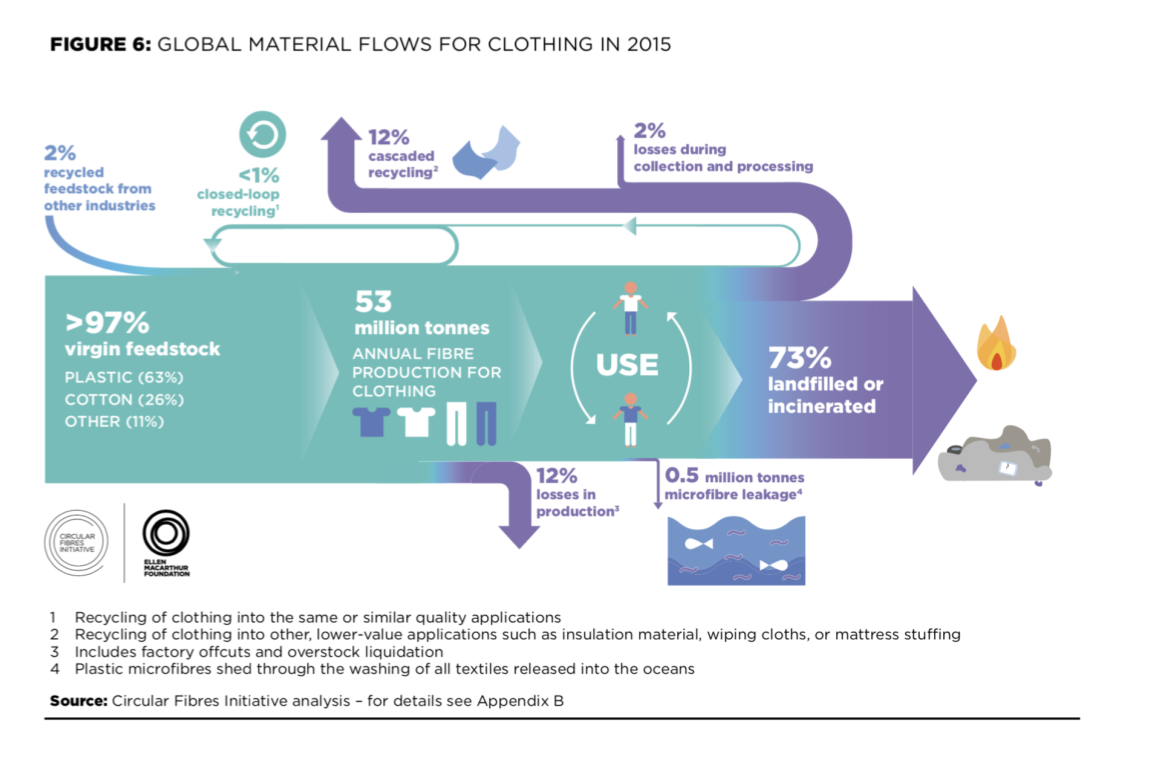
- Of the total fibre input used for clothing, 87% is landfilled or incinerated, representing a lost opportunity of more than USD 100 billion annually.
- 73% of material going into the clothing system is lost after final garment use, 10% is lost during garment production (e.g. as offcuts)and 2% is sent to landfill or incineration from garments that are produced, yet never make it to market. An additional 2% loss occurs in the collection and sorting of discarded clothing.
- One garbage truck of textiles is landfilled or incinerated every second.
Global Fashion Agenda 2020 Commitment Report
The Global Fashion Agenda 2020 commitment was a campaign that got 94 fashion brands on board to commit to being more ciruclar by 2020. It focused on getting fashion brands and retailers to take action on circularity by setting concrete and measurable targets. Most targets set on circular design (58%), followed by garment collection (49%) and recycling (46%), and the fewest set on reuse (24%).
Statistics:
- Reusing garments is considered one of the most environmentally beneficial ways to reutilise clothes. Extending a garment’s life by just three months can lower its water, carbon and waste footprint by 5-10%. However, currently only 8% of garments are re- used.
- Twenty-four percent of the signatories set 25 reuse targets, making it the action point with the fewest targets.
Pulse of the Industry Report 2018
Published by the Global Fashion Agenda, in collaboration with The Boston Consulting Group. The report scores the industry as a whole out of 100 based on sustainability targets following the strong belief that “the environmental, social and ethical challenges the industry faces today are not simply a threat, but instead an immense untapped value creation opportunity.”
Statistics:
- The demand for clothing is projected to increase at 2% per year.
- Less than 1% of all materials in clothes are recycled into new garments. Much of today’s production is designed neither for longevity nor recycling, but rather for short life cycles to encourage consumers to buy anew. The demand for clothing is projected to increase at 2% per year.
- Extending a garment’s life by just three months would lower the water, carbon, and waste footprint by 5–10% (WRAP study quoted).
Local statistics: Stuff.co.nz
- Textiles sent to Wellington’s Southern Landfill doubled since 2009 and it’s estimated that 25 per cent of it were perfectly fine clothes – that could have been recycled, reused or diverted.
- Every kilo of clothing that’s landfilled creates 3.6 kilos of greenhouse gases.
- An Auckland Council Waste Assessment from 2017 says textiles are one of the fastest growing materials being dumped in Auckland.
- Associate Minister for the Environment Eugenie Sage said there were “major gaps” in the country’s data about waste, including textile waste.
Sources:
Ellen MacArthur Foundation. “A New Textiles Economy: Redesigning Fashion’s Future.” 2017.
Lehmann, Morten, et al. “Pulse of the Fashion Industry.” Global Fashion Agenda and The Boston Consulting Group, 2018.
WRAP. “Sustainable Clothing: A Practical Guide to Enhancing Clothing Durability and Quality.” 2017.
Woolf, Amber-Leigh. “New Zealand Landfills Are Becoming Full of Unloved Clothes as ‘Fast Fashion’ Grows.” Stuff, 21 July 2019, Stuff.co.nz.
“2020 CIRCULAR FASHION SYSTEM COMMITMENT.” Global Fashion Agenda, 2018.

 Refresh Fashion Library